






 DARK

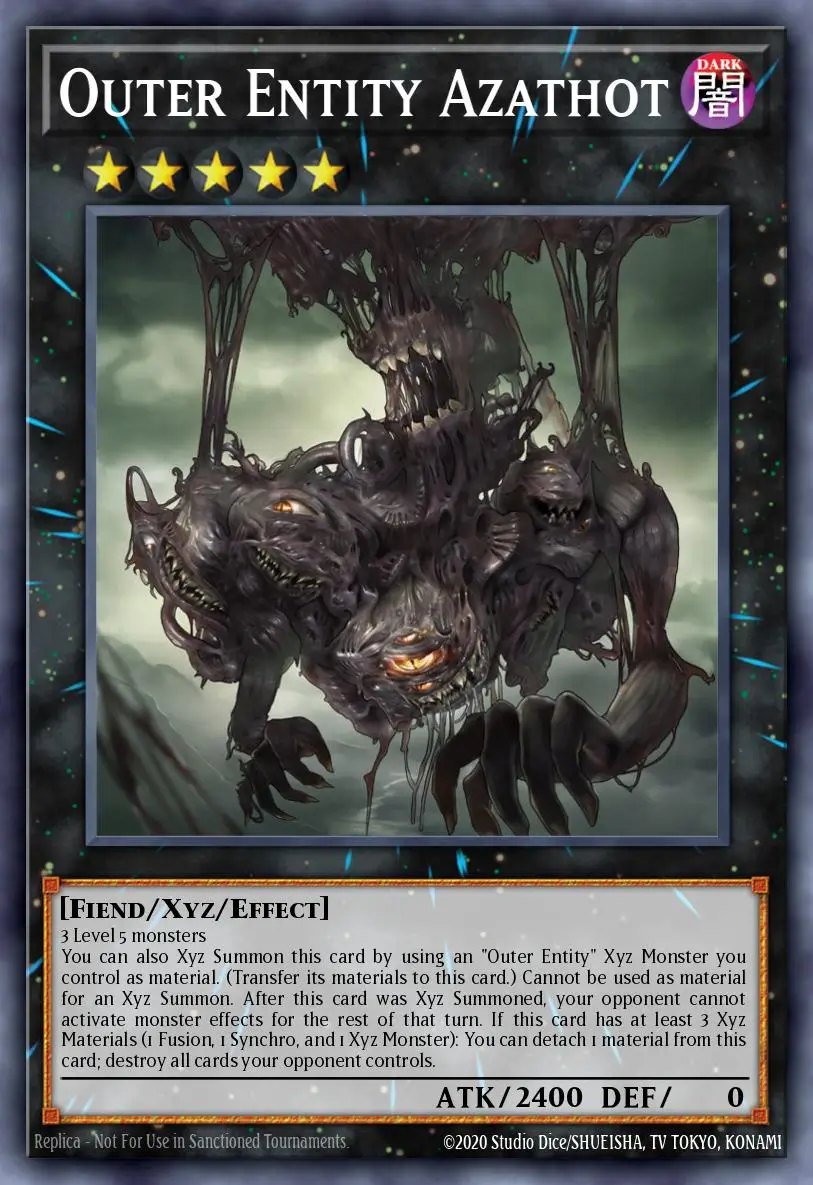
Outer Entity Azathot
ATK:
2400
DEF:
0
View:
5140
3 Level 5 monsters You can also Xyz Summon this card by using an "Outer Entity" Xyz Monster you control as material. (Transfer its materials to this card.) Cannot be used as material for an Xyz Summon. After this card was Xyz Summoned, your opponent cannot activate monster effects for the rest of that turn. If this card has at least 3 Xyz Materials (1 Fusion, 1 Synchro, and 1 Xyz Monster): You can detach 1 material from this card; destroy all cards your opponent controls.


Outer Entity Azathot — Power Evaluation
Final Score: 57 ± 6 · Confidence: Medium
- Intrinsic: 58 · Deck: 60 · Meta: provisional
- Primary role: Boss/End-board · Secondary: Negation/Interaction
Why it scores here
Outer Entity Azathot is a Rank 5 end-board piece that delivers strong but limited disruption: its negation of all opponent monster effects on the turn of summon is powerful, but does not extend across future turns or protect itself from removal. The conditional board wipe (requiring one Fusion, one Synchro, and one Xyz material) is rarely achieved in practice and remains unverified in the available deck lists. The card's high summoning cost (three Level-5 materials) and self-imposed Xyz-material lock restrict its efficiency, though its broad presence across 14 distinct archetypes confirms it fits various Level-5 generators. Without combo data, the practical depth of this card in modern strategies remains uncertain.
Axis scores
| Axis | Score | Evidence |
|---|---|---|
| Accessibility | 55 | Card appears in 27 competitive/casual decks across 14 distinct archetypes (Horus 18.5%, Fossil 18.5%, Cyber Dragon, Constellar, Tellarknight, etc.), with top partners including Level-5 enablers (Cyber Dragon Infinity, Cyber Dragon Nova, Horus suite), indicating moderate accessibility for Level-5-generating decks. (observed) |
| Combo & Conversion | 35 | The immediate effect negates opponent monster activations for the turn of summon only, providing disruption but no card advantage or board extension; the conditional three-material board wipe requires one Fusion, one Synchro, and one Xyz Monster—a highly restrictive requirement with zero demonstrated examples in the supplied combo data. (inferred) |
| Resource Economy | 40 | Summoning requires three Level 5 monsters or a prior Outer Entity Xyz, consuming significant resources; the immediate effect disrupts but does not draw, search, or refuel, and the conditional board wipe requires specific material composition unlikely to occur naturally without dedicated support. (inferred) |
| Effect & Interaction | 72 | Upon Xyz Summon, this card negates all opponent monster-effect activations for the remainder of that turn, providing strong turn-of-summon disruption; if the card holds three specific material types (one Fusion, one Synchro, one Xyz), it can destroy all opponent cards, though this condition is rarely met in practice. (verified) |
| Material Utility | 30 | Card explicitly states it cannot be used as Xyz material, self-locking from downstream Xyz refueling routes; as a standalone body, it is a 2400-ATK Rank 5 requiring three Level 5 materials to summon, making it inefficient as generic material for other synergies. (verified) |
| Resilience & Flexibility | 45 | The card's disruption effect lasts only for the turn of summon with no inherent protection against removal or negation; it can potentially be re-summoned using the material-transfer mechanic if a prior Outer Entity Xyz is maintained, providing limited recovery. (inferred) |
| Deck-Building Efficiency | 55 | Card runs as a 1-of in all 27 sampled decks, creating no garnet risk from redundancy; the requirement for three Level 5 materials is high, but the 14-archetype spread (Horus, Fossil, Cyber Dragon, Constellar, Tellarknight, Infernoble, Tearlaments, etc.) indicates many homes naturally generate this summon cost without severe deckbuilding penalties. (observed) |
Calculation
Weight profile: 0.7 × Boss/End-board + 0.3 × Negation/Interaction. Intrinsic ≈ 58, Deck ≈ 60, Meta = provisional. Modifiers: Xyz-material self-lock (-2). Final formula: 0.40*Intrinsic + 0.60*Deck
Strengths
- Strong negation of all opponent monster effects on the turn of summon (hard disruption, difficult to play around)
- Broad accessibility across 14 distinct archetypes (Horus, Fossil, Cyber Dragon, Constellar, Tellarknight, Infernoble Knight, Tearlaments, Cyberdark, Cyberse, Performage)
- Clear card text with no ambiguous rulings; material-transfer mechanic enables potential reuse/upgrade from smaller Outer Entity Xyz boards
- Synergizes well with established Level-5 generators in each home (Cyber Dragon Infinity/Nova for Cyber Dragon, Horus suite for Horus, etc.)
- Potential board wipe (destroy all opponent cards) if three-material condition is met
Weaknesses
- High summoning cost (three Level 5 monsters represent significant resource commitment without card-advantage return)
- Negation effect limited to the turn of summon; provides no protection on subsequent turns or against the opponent's next action
- No inherent protection from removal or negation (does not claim 'cannot be destroyed' or similar)
- Conditional board wipe requires very specific material composition (one Fusion, one Synchro, one Xyz Monster) that is rarely achieved in practice and lacks any combo data verification
- Self-imposed Xyz-material lock restricts downstream refueling combos in some strategies
- Runs as 1-of in all sampled decks with no redundancy hedge; if the summoning line is disrupted, no backup copy exists
- No empirical combo data to verify practical performance depth or frequency of key board states
Counters / choke points
- Monster-effect negation cannot stop trap cards or spell cards; hand traps like Ash Blossom & Joyous Spring still negate before this card lands
- Inherently weak to removal (destruction, banishment, bounce) after summon due to lack of protection clause
- Conditional board wipe is too rare to reliably counter meta decks; opponent can play around the three-material condition
- High summoning cost means the card itself is a resource sink; opponent's disruption on the summoning line leaves the deck with a wasted investment
Best use
End-board negation capstone after Level-5 generation; supplementary board wipe if three-material condition aligns. Decks: Horus (natural Level-5 generator), Fossil (Level-5-centric strategy), Cyber Dragon (Infinity and Nova provide Level-5 extension), Constellar (Level-5 Synchro/Xyz synergy), Tellarknight (Level-5 spread), Infernoble Knight (Synchro-heavy, Level-5 access). Suggested copies: 1.
Evidence & gaps
- Verified: Card text: 3 Level-5 summon cost, negates all opponent monster-effect activations for the turn of summon, self-lock from Xyz material use, conditional destroy-all-opponent-cards effect requiring 1 Fusion + 1 Synchro + 1 Xyz Material; Deck presence: 27 total decks, all running 1-of, across 14 distinct archetypes; Top partners: Outer Entity Nyarla (59.3% co-decks), Foolish Burial (48.1%), Cyber Dragon Infinity (40.7%), Horus suite (37%)
- Observed: Broad archetype accessibility: Horus (18.5%), Fossil (18.5%), Cyber Dragon (7.4%), Constellar (7.4%), Tellarknight (7.4%), Infernoble Knight (7.4%), and 8 others across 14 total archetypes; Level-5 enabler synergy: Card co-appears with Cyber Dragon Infinity (40.7%), Cyber Dragon Nova (40.7%), and the full Horus Level-5 suite (37% each); 1-copy commitment: All 27 decks run exactly 1 copy, indicating no redundancy hedge
- Inferred: Combo conversion depth: Without combo examples, the practical achievement rate and sequencing of the three-material board wipe cannot be verified; the condition is inferred to be rare; Material-transfer mechanic utility: The ability to use a prior Outer Entity Xyz as material is inferred to enable potential upgrade/reuse, but no examples demonstrate this in practice; Resource economy: The three-monster investment is inferred to be resource-negative without card-advantage follow-up; Practical negation impact: Strong text-based negation is inferred to provide one turn of disruption, but the lack of protection limits long-term board control
- Data gaps: No combos supplied — combo conversion is entirely text-based inference; cannot verify summoning frequency or resulting board states No guides supplied — no human context on practical role, matchups, or meta performance No usage statistics (StatisticsCard) — archetype inclusion percentage inferred from 27-deck sample only No examples of the three-material board wipe in action — conditional effect's practicality is unverified No master combo data — cannot assess whether the material-transfer mechanic is reliably used in practice